
In seventeenth-century America, colonial officials viewed newspapers as the source of "disobedience and heresy and . . . libels against the best government." The Governor of Massachusetts was warned, "Great inconvenience may arise by the liberty of printing."
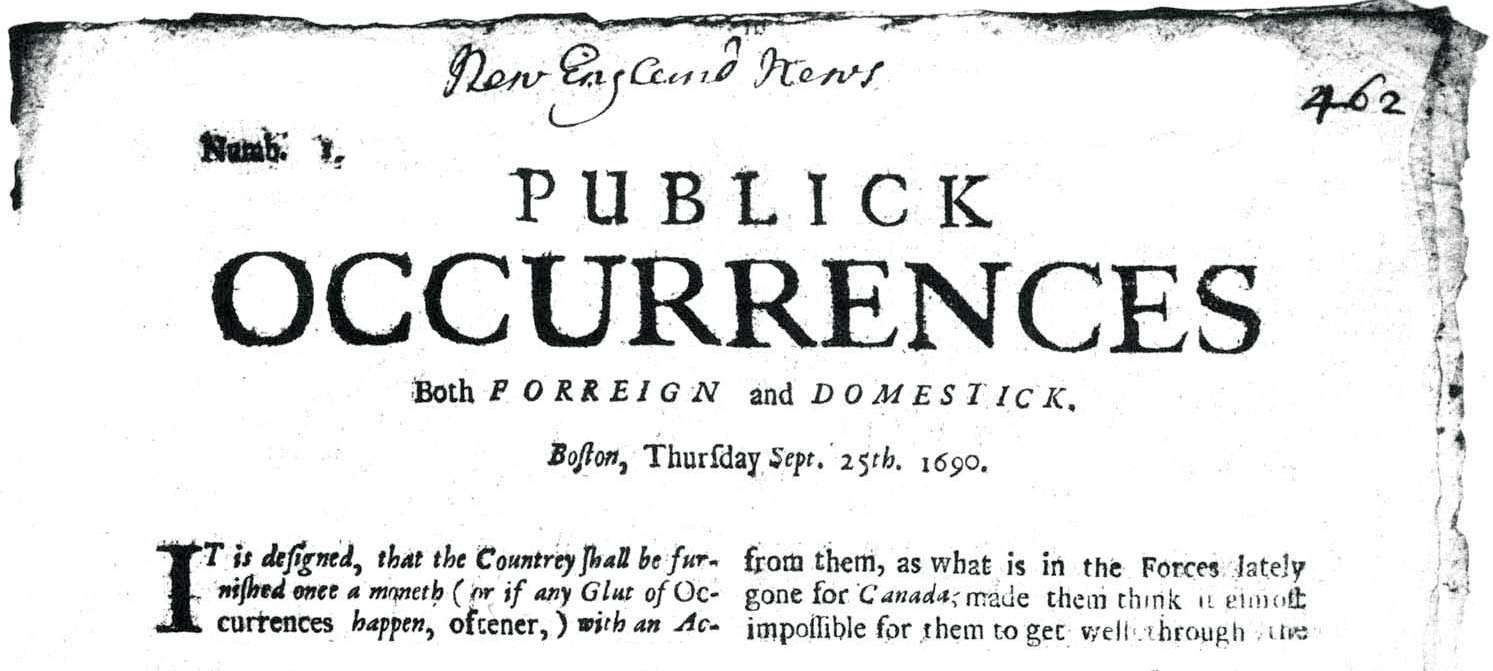
In 1690 Benjamin Harris inconvenienced the Boston authorities by publishing the colonies' first newspaper. There had been one-page broadsides printed earlier, but Harris's Publick Occurrences looked and read like a newspaper. It was four pages long and the publisher promised an issue every month, "(or if any Glut of occurrences happen, oftener) with an Account of such considerable things as have arrived unto our Notice."
Benjamin Harris's reputation is sure to have accompanied him to New England. He had published books, pamphlets, and a newspaper in London at a time when it was illegal to print anything about the government without permission. In 1679 Harris had found himself on trial for a seditious libel contained in a book printed on his press. The judge declared, "You can hardly read a more bad, and pernicious book, to put us all into a Flame." Harris was not permitted to speak in his own defense, nor was the jury allowed to read the book. He was convicted, pilloried in front of his shop, and when he could not pay the fine, sent to prison. Once released from jail, he resumed his attacks on the government. He left England with his family to avoid further prosecution.
In the four years after Harris arrived in Boston, he achieved success with a variety of businesses. He ran a bookstore, print shop, and popular coffeehouse where men gathered to discuss current events. Harris's print shop at first produced commonplace books such as almanacs, school primers, and the Bible. On September 25, 1690, he produced the first edition of Publick Occurrences and immediately found himself in trouble once again.
The governor's stated objection to Publick Occurrences was that the paper contained "sundry doubtful and uncertain Reports." In truth, the governor was outraged because Harris had printed rumors of incest and immorality in the French royal family and had also criticized the British military for mistreating French prisoners during the first of the French and Indian Wars. Apart from the content, Harris had committed a serious offense simply by printing his paper without permission. The paper was suppressed; he remained in Massachusetts and was allowed to continue printing various public documents. When he returned to England in 1695, he was arrested for publishing another short-lived newspaper, but this time, the political climate was less repressive. He was released and for the next five years, he published the London Post.
As one historian concludes, "the first newspaper published in America became the first to be suppressed by the authorities." The government's action was effective. It was not until 1704 that the colonies' second newspaper appeared. Also a Boston venture, this one enjoyed government approval. The Boston Newsletter lasted for 74 years.
Sources
"Early American Newspapering," by James Breig in Colonial Williamsburg Journal
"Eighteenth-Century American Newspapers"
Freedom of the Press: An Annotated Bibliography, by Ralph McCoy.
"Newspapers in the Boston Public Library, Background"