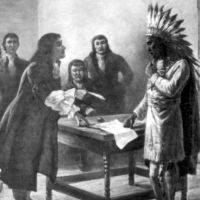

...in 1694, Abenaki warriors raided the frontier town of Groton, on the western edge of Middlesex County. Striking at daybreak, they killed 20 people and took 12 captives, most of them children. More than 1,600 New Englanders were "carried off" by Native Americans between 1677 and 1763, when the Treaty of Paris brought the French and Indian wars to a close. Some captives were freed or exchanged; some were compelled or chose to remain with the Indians. The fate of many will never be known. One victim of the Groton raid, John Shepley, spent four years as a captive in Canada before returning home. He survived a second Abenaki attack on the town in the summer of 1704.
At the end of the seventeenth century, Massachusetts essentially had two settled areas. A string of English towns ran up the Connecticut River Valley from Springfield north to Deerfield. The rest of the colonial population was clustered within 40 miles of the coast. This put Lancaster, Groton, and Haverhill on the frontier between the coastal settlements, which the English victory in King Philip's War made secure, and territory the colonists had largely ignored. These villages were vulnerable to Indian raids.
Groton had been badly damaged during King Philip's War. In March 1676, Nipmucs had burned the meetinghouse and 40 homes to the ground; residents fled to Concord. Two years later, they returned and rebuilt their dwellings, including a number of garrison houses for protection against the Indians. An uneasy peace prevailed for the next 16 years.
Between coastal New England, claimed by the English beginning in the 1620s, and the St. Lawrence River Valley, claimed by the French, lay a vast, vaguely defined area inhabited for more than 10,000 years by Abenakis. Both the French and the English traded with the Native Americans, and often vied for Abenaki help in their conflicts with each other. At other times, Abenakis sought European aid to subdue their own enemies. The alliances were complex and unstable, but the most common pattern was for Abenaki warriors, who had closer ties to the French than the English, to raid English settlements on the Massachusetts frontier.
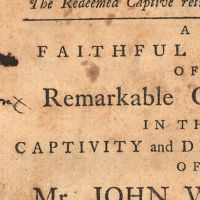
The taking of captives during conflicts played an important cultural role in many Native American tribes. Captured individuals were often adopted into families to take the place of deceased relatives. In one of the captivity narratives that were popular in colonial Massachusetts, Joseph Bartlett described how, after he was captured in a raid on Haverhill, he was handed over to "an old squaw" and told that he "need not fear for [he] was given to the squaw in lieu of one of her sons, whom the English had slain." Indians also sold captives to the French, who either ransomed them or exchanged them for French prisoners held by the English.
Although many native tribes treated their English captives well, Massachusetts Puritans claimed to prefer instant death to capture. Not only did they envision a gruesome death at the hands of people they regarded as "savages," but an even worse fate might befall them if they ended up in one of the Abenaki villages where a Jesuit missionary lived. The possibility that English men, women, and children might be instructed in Catholicism filled Puritans with dread. Captives taken to French Canada faced the same danger.
When Queen Anne's War ended in 1713, Groton had 18 garrisons in town in which 58 families could find refuge. More than 25 years of peace followed before King George's War broke out in the 1740s and the Seven-Year War (known to Americans as the French and Indian War) in the 1750s. The bloody struggle between the English and French over who would dominate the North American continent finally ended when France surrendered Canada to the British in 1763.
Sources
Downland Encounters: Indians & Europeans in Northern New England, ed. by Colin G. Calloway (University Press of New England, 1991).
Empires at War: the French and Indian War and the Struggle for North America, 17541763, by William M. Fowler Jr. (Walker & Company, 2005).
Groton During the Indian Wars, by Samuel A. Green, MD (University Press, 1883).
The Unredeemed Captive: A Family Story From Early America, by John Demos (Vintage Books, 1994).