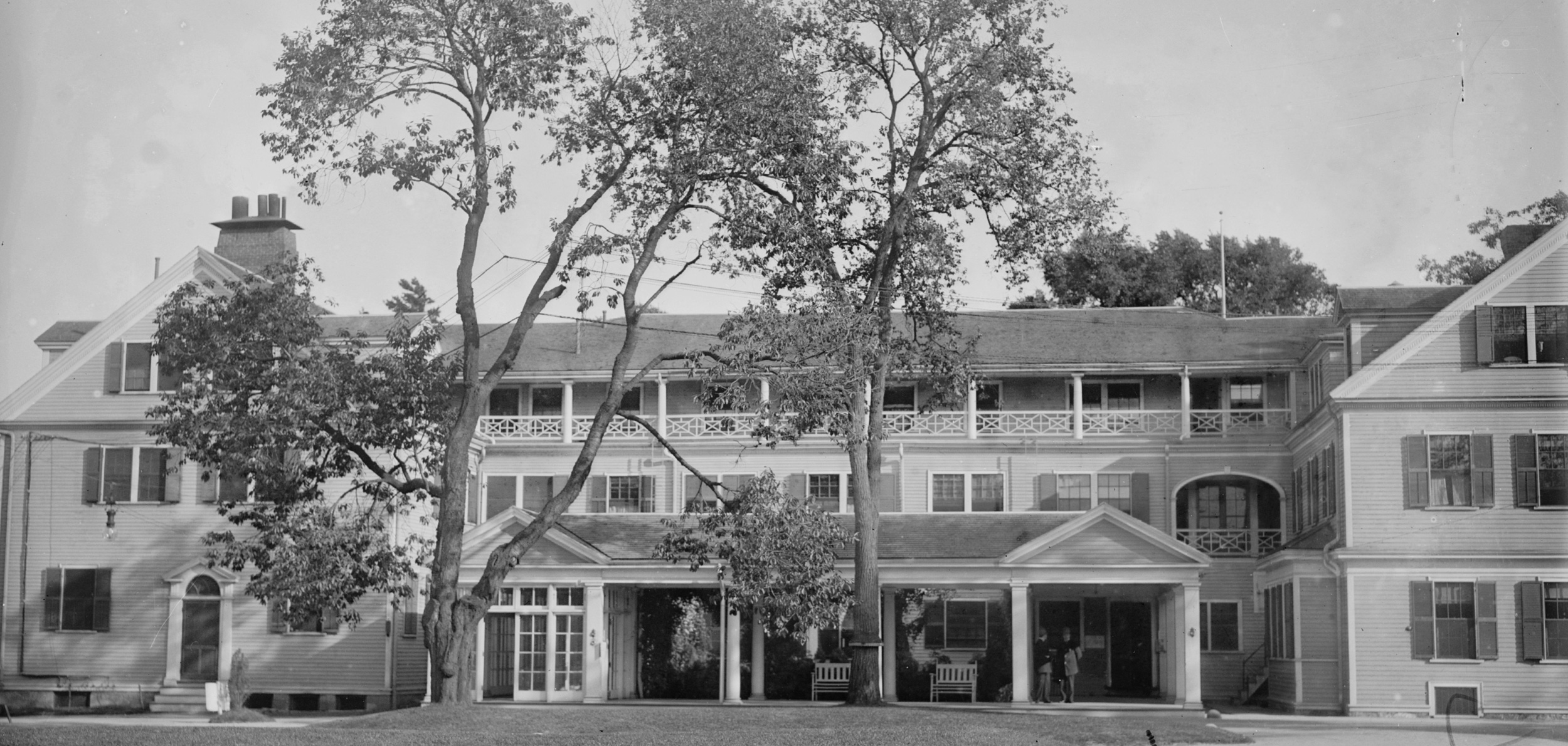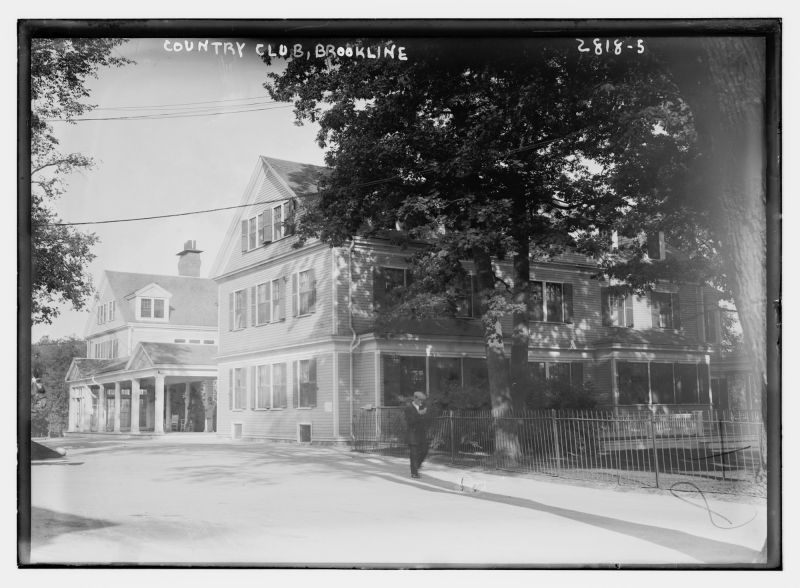

In January of 1882, a group of wealthy men from the Boston area established the first country club in the United States, The Country Club of Brookline.
In the second half of the nineteenth century, growing numbers of affluent families moved out of Boston to newly developed suburbs like Brookline. By 1880, men who spent their days working in the city's banks, law offices, and businesses might have lunch in a downtown men's club, but they were choosing to spend their evenings and weekends in greener settings.
Brookline's location made the town attractive to wealthy families looking to move away from the city and its problems. The exodus had begun in the 1840s when well-to-do urbanites started spending summers "in the country." After the Civil War, summer retreats were transformed into year-round residences. New trolley and train lines made it possible for businessmen to live in the suburbs and work in the city.
As Brookline grew, its prosperous residents created a new kind of social club to meet their changing needs the country club. Here, they could demonstrate their affluence and refinement by engaging in elite pursuits such as fox hunting, horse racing, ice skating, tennis, and, later, golf close to home.
While downtown men's clubs were exclusively male, country clubs allowed women to spend leisure time with their husbands. Few if any country clubs accorded women full membership privileges, but wives and daughters were permitted to participate in many of the club's activities, although in some cases on the golf course, for example they did so only in all-female groups.
As a place where men, women, and children socialized together, the country club represented the ideal of upper middle-class family life. Writers praised the wholesome atmosphere and claimed the country club was the perfect antidote to the competitive, commercial nature of urban life.
The country club also offered exclusivity. Although wealth was necessary, it did not guarantee membership. One had to be invited to join. This allowed the elite to exclude people whose social, ethnic, religious, or racial background made them unacceptable companions on the golf course or in the dining room. The restrictive policies of most country clubs, which excluded Jews, Catholics, and blacks from membership, remained in place into the late twentieth century and are informally in effect at many clubs even today.
In 1882, a member of one of Boston's wealthiest families, J. Murray Forbes, organized a group of his friends to acquire a rolling expanse of land in Brookline. They renovated a farmhouse into an elegant clubhouse with dining, card and billiard rooms, and accommodations for those who wished to sleep over.
They built a track for horse racing, grass tennis courts, a bowling alley, and polo fields. They organized a variety of activities from skeet shooting to afternoon concerts and then invited prospective members to join them in their pastoral paradise after, of course, paying an initiation fee and membership dues of $50 a year (the equivalent of about $1,000 today).
The early days of The Country Club at Brookline were marked by conflict as well as congeniality. Devotees of the new game of golf defied the state's blue laws to play on Sundays, generating complaints that the game was corrupting public morals. One Sunday, over 30 members were arrested and hauled off to court. Soon afterwards, the club's influential members helped persuade the legislature to lift the Sunday ban.
There was also friction between the equestrians and the growing number of golfers. Because land was limited, the original golfcourse overlapped the horse track. The horse lovers were incensed when golf balls whizzed over their heads. They called the golfers "idiots intent on chasing a Quinine pill around a cow pasture." When the course was expanded to 18 holes in 1899, the club's horse racing, polo, and trapshooting enthusiasts objected to the "ruthless cutting down of fine trees to satisfy the whim of the Golf Committee."
As the Brookline club worked out this and other issues, it provided a model for similar clubs that were cropping up around the nation. By the turn of the century, there were over 1,000 country clubs in the U.S., with at least one in every state and territory.
Sources
The American Country Club: Its Origins and Development, by James M. Mayo (Rutgers University Press, 1998).
Streetcar Suburbs: The Progress of Growth in Boston, 1870-1900, by Sam Bass Warner (Harvard University Press, 1978).
The Greatest Game Ever Played: Harry Vardon, Francis Ouimet, and the Birth of Modern Golf, by Mark Frost (Hyperion, 2002).